Types of refrigerated containers
Choose a refrigerated container for the job it has to do. Holding chilled stock, freezing goods fast, storing at ultra-low temperatures and building a modular cold room all need different equipment.
Choose a refrigerated container for the job it has to do. Holding chilled stock, freezing goods fast, storing at ultra-low temperatures and building a modular cold room all need different equipment.
“Reefer container” is a broad term. It doesn’t tell you whether a unit is designed to hold cold stock, cool a warm batch or reach a very low temperature.
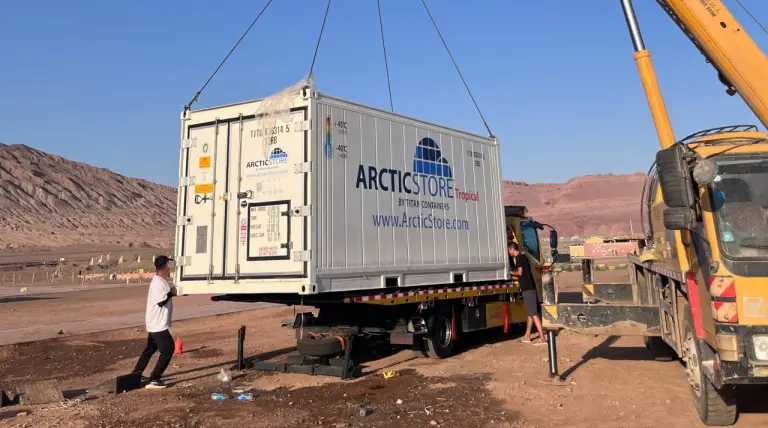
This guide covers TITAN’s stationary cold storage, which is designed to work at your site – not to cool goods while they’re shipped overseas. Every refrigerated model we offer is part of our ArcticStore collection – which also includes a heated unit, the HotStore.
Start by looking at your product’s temperature needs, its arrival temperature, your peak volume and how you’ll handle it. Then you can compare the types that fit.
| Model | What it’s for | Temperature range | Sizes |
|---|---|---|---|
| ArcticStore | Holding chilled and frozen goods | -40°C to +45°C | 10ft, 20ft, 40ft |
| ArcticStore Horizon | Energy-efficient storage with solar panels | -30°C to +30°C | 40ft |
| ArcticBlast | Rapid chilling, freezing and tempering | -40°C to +45°C | 20ft, 40ft |
| Arctic UltraFreezer | Ultra-low temperature storage | -75°C to -10°C | 20ft, 40ft |
| Arctic SuperStore | Modular open-plan cold room | -40°C to +45°C | Built using 20ft and 40ft modules |
| Arctic MegaStore | Two-story modular cold storage | -40°C to +45°C | 40ft modules |
| HotStore | Heated storage | +45°C to +85°C | 20ft, 40ft |
A modular cold room such as an Arctic SuperStore or MegaStore is custom-built to your site’s requirements.
There’s a lot to take in when assessing different types of refrigerated containers, so ask us to help shortlist suitable options, based on your product, temperature and capacity requirements.
ArcticStore is our signature cold store and the go-to choice for most TITAN clients. It gives you walk-in cold space in 10ft, 20ft and 40ft sizes, and you can set it to any temperature from -40°C to +45°C.
Use it to hold goods that need the same temperature. One unit holds one temperature at a time, so if you need to keep both chilled and frozen goods, you’ll need separate units.
Size it around a load you can actually work with. Access to the stock and airflow around it count toward overall capacity, not extras you squeeze in after you’ve counted the pallets.
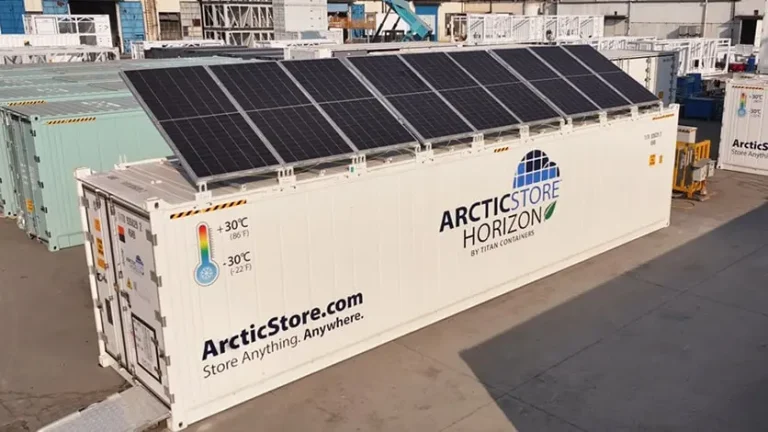
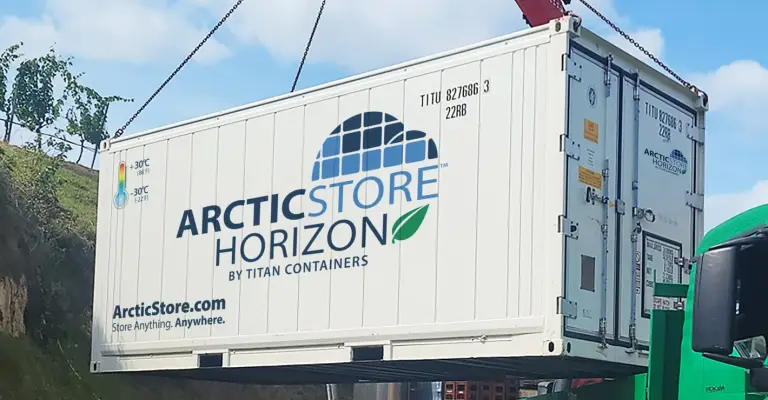
ArcticStore Horizon has vacuum insulation panels and roof-mounted solar panels, which together cut its energy use by 55% on average compared with a traditional reefer. It comes in 40ft and holds any temperature from -30°C to +30°C.
That makes your product’s required temperature range one of the first things to check. Horizon isn’t right if your goods have to reach -40°C.
It also still needs a suitable external power supply. The solar panels don’t make it an off-grid container, and they won’t keep your goods safe during a power outage.
ArcticBlast is built for rapid chilling, freezing and tempering. It comes in 20ft and 40ft sizes.
The right size depends on how much you need to cool and how fast. So tell us what you’re cooling, how much of it there is, what it’s packed in, the temperature it starts at, the temperature you need and how long you’ve got.
Don’t go by a blast freezer’s temperature range alone – it doesn’t tell you how fast a load will cool. And allow time to load and unload between batches.
Arctic UltraFreezer operates from -75°C to -10°C and comes in 20ft and 40ft sizes. It’s for products that have to be kept colder than a standard freezer can manage, such as certain vaccines and oily fish like bluefin tuna.
Choose it for a product with a defined temperature requirement. Storing at ultra-low temperatures also affects how you handle the goods, how you monitor them and what you do if the unit fails, so talk it through with us before you decide.
It isn’t an upgrade for every frozen product. If a standard freezer does the job, it’s the simpler choice.
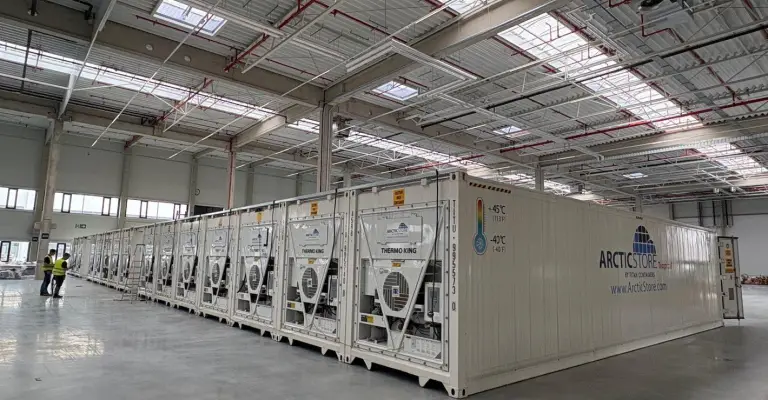
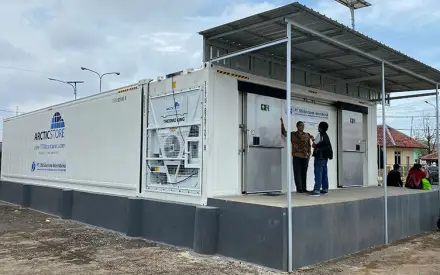
Arctic SuperStore combines modular units into one large open-plan cold room – or you can split it into individual zones with different temperatures. It’s great when you need lots of space to move around freely, or when easy-access bays suit you better than individual containers.
Plan the doors, where the stock will sit, the routes staff will take and any temperature zones around how you work. Zones need internal dividing walls and doors.
A SuperStore doesn’t come in a standard size, so there’s no fixed width or capacity to look up. Tell us how much you need to store and how you work, and we’ll design a layout that works.
Our Arctic MegaStore is a two-story cold room built from stacked 40ft units, giving you roughly double the storage volume on the same footprint. It starts at eight units, four on the ground and four on top, so it suits large requirements, not small ones.
Before you decide, consider the working height, how goods will move and what handling equipment you’ll use. The forklift limit is about 6.2ft by 6.6ft, so a pallet lifter is often the better choice. Extra height only helps if your team can use it safely and efficiently.
HotStore is a heated container, not a refrigerated one. It holds any temperature from +45°C to +85°C and comes in 20ft and 40ft sizes. TITAN’s customers use it to keep chemicals at the right viscosity, to heat-test components and products, and as a large industrial dryer.
If you only need gentle warmth, or you’re thawing or tempering frozen goods, use an ArcticStore or ArcticBlast instead. TITAN recommends them for that job, because both warm up to +45°C and hold the temperature evenly.
If your job has hot and cold stages, talk to us. We’ll help you create a setup that matches your needs.
No two businesses are the same. A food producer might need to cool a new batch fast, hold the finished frozen goods for several weeks and keep chilled ingredients ready for the next shift. That’s three different jobs, and one low-temperature specification doesn’t cover all three.
Start with the new product you need to cool each day, and how quickly it has to reach the required temperature – this may be best handled by an ArcticBlast.
Then, think about where it goes next, because you’ll need space to keep frozen goods until they’re collected.
Finally, think about any chilled ingredients you need ready for the next production cycle. They need a different temperature from the frozen goods, so they need a separate container. You may end up with an ArcticBlast to cool the new batches and ArcticStores to handle everything else.
For a different business, the only need might be overflow chilled stock during a seasonal peak. A single ArcticStore could cover that on its own.
Start with the temperature, and whether the job is holding stock or cooling it. Then look at peak volume, layout, site access, power and how long the chilling or storage job will last.
If your products need different temperatures, plan separate units or a modular setup with individual zones. And if future demand is uncertain, say how it might change when you talk to us.
Request a cold storage quote with your details, and we’ll help compare suitable reefer container types.
It’s mostly the temperature it’s set to. An ArcticStore can be set to a chilled or a frozen temperature, but one unit holds one temperature at a time. If you need both, you’ll need two units, or a SuperStore with separate temperature zones. So the chiller vs freezer container choice comes down to the temperatures your product needs.
The Arctic UltraFreezer, which goes down to -75°C. Check it matches the temperature your product needs, and that you can handle and monitor goods stored that cold.
No. Only the ArcticStore comes in 10ft. The other types start at 20ft or 40ft, as shown in the table above.
No. A modular Arctic SuperStore or Arctic MegaStore joins its units into one connected open-plan space, while separate containers each keep their own interior and door. Choose by how your stock and staff need to move around, the temperatures you need and the space on your site.
If you just need to hold goods at one steady temperature, a standard refrigerated container will do the job. You need a specialist unit if you have to cool warm product quickly (ArcticBlast), store below -40°C (Arctic UltraFreezer), build a large connected cold room (SuperStore or MegaStore) or keep energy use down (Horizon).

Josefine Falch is Global Marketing Manager at TITAN Containers, responsible for driving global marketing strategy, brand positioning, and lead generation across key industries and markets. With a strong focus on data-driven marketing, international campaigns, and cross-market alignment, she works closely with local teams to support commercial growth and strengthen TITAN’s presence worldwide.